Friday, May 29, 2015

How to Use Your Content Platforms to Gain Valuable Customer Insights

How to Use Your Content Platforms to Gain Valuable Customer Insights written by Guest Post read more at Small Business Marketing Blog from Duct Tape Marketing

Audience data 240x180You don’t need to spend thousands of dollars on industry research or surveying your audience — most small businesses already have plenty of data collection tools right at their fingertips! The savviest businesses utilize their content to gain invaluable insights into their customer and potential customer base to understand what they want most- here’s how you can too!

Google Analytics

To get a good baseline for who your audience is, use your website’s Google Analytics data. On the left sidebar, click audience, then explore the demographics, interests, and geo sections. The location, age, gender, industry and topical interests of your website traffic is all displayed in these section. The interests section of your audience report contains particularly insightful gems. Affinity Categories relates to the other lifestyle interests they have, while In-Market Segments shows you their product and purchase based interests. Other Categories hones in on the most specific topics of interest or activities.

Blog Topics

Which blog posts get the most shares, views, or impressions on your blog and across your social networks? It’s important to distribute your blogs across a wide variety of platforms to get a feel for as many different segments of your audience as possible, as well as to get a better sense of the piece’s success. Sharing your blogs widely across the web also brings more traffic back to you site, and continues to feed into what your insights.

Downloaded Resources

You should make a few helpful pdf downloads available on your website. Not only is this a great way to capture emails, but it’s also a useful tool to see where your audience’s interests lie, or what problems are currently affecting them. Make sure all your resources relate to your business in some way- it wouldn’t be particularly helpful to learn what someone’s favorite color is or where they would most like to vacation.

Emailed Content

Whether you use a full on CRM like Salesforce or a simpler service like MailChimp- take note of what content your readers are clicking on. When sending them blog updates, industry news, or new services offered- note where their interests lie. Deliver more, similar content to see if you can hone in on the specific topics they care most about. Optimize your newsletters for key learnings.

Quizzes

People love quizzes, especially on social media. It’s also a genius way to learn more about your audience than any other technique. An easy tactic to start is a quiz themed to “What ___ Are You?”. Make sure you come up with questions that will help you in your your quest to understand your audience, such as “do you like to attack and solve problems, or do you seek the advice of others?”.

Facebook Insights

Immediately upon logging into Facebook, navigate to the left side menu and select Insights. You’ll find your Facebook audience demographics under the People category. Be sure to also note the section for when your fans are online to see what types of content you should be sharing to this audience. Lunch hour readers prefer entertainment, while morning browsers are primed for news. Long reads are best for the evening and weekend. For many brands, their Facebook audience consists of different groups, using Facebook at different times. Optimize your Facebook posts for greatest potential to collect the most audience data possible.

Twitter Analytics

Every user can now access their Twitter analytics. Similar to Facebook, Twitter’s Analytics lets you see basic audience demographic information (do you see any differences between your Facebook and Twitter audiences?) as well as an overview of your tweet performance. Twitter add-on Followerwonk assesses the bios of your followers to provide you with insights on their interests and how they describe themselves. You can see who else your followers tend to follow, what they tweet about and Followerwonk points you in the direction of new groups to go after (moms who love DIY or dads who like soccer).

LinkedIn Audience

When viewing your company page, select Analytics. You’ll see a concise listing of your posts’ performance as well as audience demographics. LinkedIn shares what level of professional attainment your followers are: entry-level employee through owner or VPs. You can also select Industry and Job Function from the audience data drop down menus. It’s highly advisable to appropriately tailor your content to appeal to the right level of reader: decision maker or someone who might suggest your company to the decision maker.


pro pic 150Diana Mackie is a small business writer, specializing in marketing and content. Diana writes for AllBusiness, Huffington Post, Social Media Today, Duct Tape Marketing and many other publications. She is currently the Chief Content Officer at Funding Gates. Diana attended Fordham University and now lives in New York City.

Thursday, May 28, 2015

How Customer Photos Improve Mobile Shopping

How Customer Photos Improve Mobile Shopping written by Guest Post read more at Small Business Marketing Blog from Duct Tape Marketing

Mobile commerce is expected to grow nearly 50% in the next four years.

But even with the rapid rate of tablet and smartphone technology, there are still many advantages of web over mobile for creating a seamless online shopping experience. This is strongly reflected in the still lagging mobile conversion and purchase rates—mobile’s conversion rate lags over 3.5x behind desktop. With consumers spending more and more of their online time on mobile, brands are turning to content generated by their customers to improve the mobile shopping performance.

Mobile commerce still lags significantly behind desktop when it comes to e-commerce.

  • Mobile conversion is generally terrible (0.6% conversion on smartphones in 2013 vs. 2.2% conversion on desktop)
  • Consumers rate mobile as the “most difficult” method for completing an online purchase compared to other purchasing channels
  • Customers rarely make purchases through mobile devices, and when they do, transactions made on mobile are on average much smaller.

Some reasons for mobile’s low reviews include:

  • Low bandwidth that limits photos and load times
  • Small screen that clutters and/or eliminates information
  • Difficulty in mobile app downloads

User-generated content from social media has become a valuable resource to combatting the mobile commerce chasm. For one, your customers are using social media on mobile (social media usage from mobile increased 23% in 2014.)  They are browsing and posting pictures across social channels on their mobile devices.  This means that when it comes to using their phones– your customers are mostly being exposed by content generated by their friends and/or influencers they follow. By displaying customer photos within native shopping apps and on mobile e-commerce websites, your brand can begin to bridge the customer experience gap between social media and mobile commerce.

So what are the general takeaways to why customer photos and social media content are so effective at improving the mobile shopping experience?

  1. Consumers are accustomed to seeing social photos from their mobile devices
  2. Integrating social content into mobile commerce helps connect the shopping experience to the larger consumer mobile behavior
  3. Customer photos are incredibly engaging and offer strong social proof of brands and products
  4. User-generated content is more engaging than custom or stock photography

Kenneth ColeCharlotte Russe

Kenneth Cole and Charlotte Russe place user-generated content on their mobile sites to enhance the customer shopping experience.

Social media plays a large role in improving the mobile experience and can be more than a channel for customer engagement. Customer photos can be leveraged to help personalize the mobile shopping experience and offer strong social proof of your brand and products. By integrating user-generated content into native apps and mobile web, your brand will begin to move the needle to drive higher mobile conversion rates and sales.

Kyle_Wong_PixleeKyle Wong is the CEO & Co-Founder of Pixlee, a SaaS platform that helps brands leverage customer photos to improve marketing. Kyle has been featured in Forbes’ 30 Under 30 List and is a regular speaker and domain expert on influencer marketing and driving consumer engagement through social media.

Stay On Top Of Modern Marketing

Stay On Top Of Modern Marketing written by Guest Post read more at Small Business Marketing Blog from Duct Tape Marketing

“Youth Is the Engine of the World” – Matisyahu

Since I started writing my new book, YouthNation, last summer, the changes I have been studying have evolved in some instances more quickly than I could type. The groundswells from urban corners to suburban shopping malls are dictating the future of the American business economy.

Where would our nation be without Google, Facebook, Amazon, Tesla, or Twitter? Apple, a technology company, has the largest market cap on Wall Street and looks to be running away with that title. No longer do bellwether blue-chip titans hold the keys to our future. Instead, it’s a group of upstart millennial-minded organizations that are changing the face of communications, media, commerce, and transportation.

The problem is that there are still so many companies whose leadership is on the outside looking in. When I spoke at a conference of more than 200 digital marketers last month, I asked how many had heard of WeWork — a $5 billion company that’s changing the face of commercial real estate. Just two raised their hands. And this was an audience of professional digital marketers! Most of the rest of the country is even further on the fringe of this revolution.

In the 1960s and 70s, youth culture was counterculture, fighting big business and big government in an effort to be heard. They had to protest in big groups and stage be-ins and other happenings to effect change. The seminal event of that counterculture, Woodstock, attracted what was, in 1969, a mind-blowing 400,000 people. The Electronic Daisy Carnival draws more than that to Las Vegas Every Year. The power of youth in sheer numbers, share of voice, and macroeconomic impact is greater today than ever before.

So what can you do, as a modern marketer, to stay on the right side of disruption? Here are a few modest suggestions:

  • Change the way you consume news: Curate your news from those who you respect, using tools like Nuzzle, which aggregate the headlines that are shared by the people you follow.
  • Learn about emerging startups. Attend conferences and read blogs to keep abreast of companies like the aforementioned WeWork, Kickstarter, Postmates, and so many others, which are disrupting fabled industries that have remained static for nearly a century.
  • Search platforms like Skillshare where (very inexpensive) classes can keep your skills fresh in shifting areas such as search engine optimization and mobile design.
  • Choose your sources wisely. Increasingly, traditional media sources are becoming also-rans, as the most important news is broken by platforms like Mashable, and by influencers who are close to the industries being affected.
  • Learn the new social platforms, even if they seem silly at first. If the first wave was Facebook, Twitter and LinkedIn, the second wave is Instagram, SnapChat and Pinterest. Doing a deep dive and using them actively will enable you to fully understand these tools, and will spark ideas on the ways your business can use them.

Yes, the world continues to change, and for many, the changes are scary. But the new forces are easily accessible, so you are now more empowered than ever before to harness these changes and catapult your business to new heights. If you’d like to go deeper, YouthNation may serve as a roadmap.


Matt_Britton_72_DPIMatt Britton is the founder and CEO of innovative ad agency MRY, and the chair and co-founder of @CrowdTap, the people-powered marketing platform. On Twitter, he’s @MattyB.

Online Dating – You Need To Know What You Want First

Get the Penguin Method Here http://penguinmethod.info

When it comes to online dating, you must first question yourself what you are looking for. Are you looking for someone to be your friend in hopes that something more develops. Are you into just a hook-up? Are you looking for your soul mate but realize that you’ll have to go through a number of people to find that match?

Read More »

The post Online Dating – You Need To Know What You Want First appeared first on Instant Infatuation Formula.

Friday, May 22, 2015

The Minimalist Guide To Managing Your Brand Reputation Online

The Minimalist Guide To Managing Your Brand Reputation Online written by Guest Post read more at Small Business Marketing Blog from Duct Tape Marketing

A dissatisfied customer, on an average, tells 25 of his friends, while a happy one tells only 15. Seems like if good reviews spread like wildfire, bad reviews would be rushing with light speed. Reviews, and how the masses consume them, are human nature, but this human nature can be fatal for online businesses especially at a time when 8 out of 10 customers treat and trust online reviews just like personal recommendations.

Let me tell you, brand value is diluting. And it marks an uprise of a generation of advocates and influencers that are a part of the crowd our customers identify with.

So here is a quick look at the ways you can ensure that your online brand reputation shines forever like gold and earns you higher AOVs, bigger ROIs, and ever increasing conversions.

How to ensure that each product has at least five reviews

Tip #1: Ask and ye shall receive

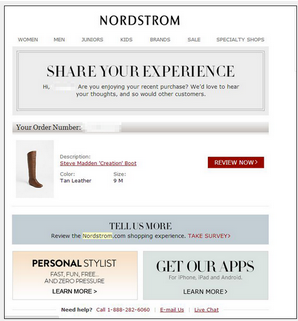
Most customers will happily review your product if you ask for it. Just call them up or send a follow-up email. This picture here shows how to get reviews on site through email:

Screen Shot 2015-05-05 at 10.55.46 AMTip #2: Give an incentive for review

For the hesitant ones, incentivise the review process. Run a reward point campaign or a loyalty program. [editor note – the FTC frowns on this practice unless you disclose that the review was incentivized.]

Tip #3: Poach the influencers

Dig out the people whose reviews are most trusted and offer them freebies or trial packs to ensure that each product has been reviewed.

How to manage third-party reviews (off-site)

Screen Shot 2015-05-05 at 10.56.03 AMManaging third-party reviews can get a little twisted if you do not have an automated services like Yotpo, which will syndicate all reviews in one dashboard and give you a chance to monitor and reply them instantaneously.

The first thing you need is a customer content service and second, a Godly omni-presence. Staying social does help, but so does having a profile on every review site. A great idea would be to have a separate profile, maybe on Twitter, to handle customer complaints.

Finally, be open and amiable. A demonstration of ‘respect for your customer’s opinion’ and ‘openness to take up criticism in stride’ will take your business a long way in fetching you repeat, happy customers.

How to build a positive reputation online and leverage customers’ trust

Most of the marketing experts unanimously vouch for one factor that gets most conversions, which is openness for customer opinions.

Step #1: Patiently listen to your customer.

Step #2: Respond instantly, but in an appreciative, comforting tone.

Step #3: Be vigilant.

If you find a great review somewhere, spread it on social media and display it on your site as a badge of honor and proof of great service.

Pay special attention to negative reviews. Do not leave them unaddressed. As much as you try to delight your happy customers through giveaways and discounts, try to make amends with the angry ones too. Apologize with a genuine voice and thank them for pointing out the potholes in your service. Send them goodies or vouchers if they are really unhappy with your service. However, do not do this too often or with everyone as it will encourage bad reviews more than good ones.

Believe it or not, customer reviews boil down to one thing – perceived value or customer expectation. If you set it too high on your website and the product doesn’t live up to it, your customer is going to feel disappointed. Keep the product copy unique and compelling but do not exaggerate its features.

parasParas heads Product Marketing at TargetingMantra, a SaaS company that lets ecommerce retailers create a personalized shopping experience for their customers just like Amazon and Zappos. An expert in Personalization and behavioral targeting, Paras has consulted over 50 clients across the globe on conversion optimization and increasing customer loyalty. He is a serial entrepreneur from IIT-Guwahati and Indian School of Business, who loves to spend his time exploring new technologies. Connect with him on Twitter and LinkedIn.

Thursday, May 21, 2015

5 Ways to Produce Eye-Catching Content Without a Designer

5 Ways to Produce Eye-Catching Content Without a Designer written by Guest Post read more at Small Business Marketing Blog from Duct Tape Marketing

photo credit: kaboompics

photo credit: kaboompics

There’s nothing like great content. I create it for work. I create it for fun. Crazy? Perhaps. Especially since creating good, visually appealing content is a huge challenge faced by many.

There is no rule that says you have to hire a pricey graphic designer in order to generate beautiful, design-rich content.  Of course, design specialists are a great resource to have on a team – but, for many earlier-stage businesses, increased costs and headcount may not be ideal.

Luckily, a universe of tools exist that enable quick content creation for even the non-designers among us – whether it’s as simple as a quick meme or as elaborate as an ebook. Slim, bootstrapping teams could wear a designer hat and produce the rich content quickly and inexpensively by enlisting some of these fantastic content-producing tools:

Capture the moment with Skitch

Screen Shot 2015-04-29 at 7.32.16 PMSkitch is a great app that helps brands tell a visual story – and it’s free! Grab a quick screenshot on your device and mark it up with arrows, boxes, text and more. Skitch lets you mark up images, digital assets, PDFs, and other files with arrows, callout boxes, text, and more.

I find that at least once a day I use Skitch’s “Screen Snap” function to grab all or part of my screen for use in content. I don’t need to plug my captured image into another program for further cropping and other editing since the all-in-one features of Skitch enable me to do so right in their app. A great time saver and useful tool for supporting your talking points with a rich visual design.

Skitch is owned by Evernote but does not require an Evernote account to start using. Try it out and screengrab to your heart’s content.

Don’t use any old font, use Dafont

Screen Shot 2015-04-29 at 7.32.42 PMSick of using Times and Ariel in your creative. Aren’t we all? Luckily, resources like Google Fonts, Font Squirrel and more offer a wealth of wonderfully designed, open-source fonts to add a little character to your characters.

I like Dafont for its abundance of options that range from general purpose to highly specialized. Each font is well-tagged so the site’s great search function could pull up just what you’re looking for. Simply download, install and use a desired font in graphics, presentations, ebooks and more – just make sure to check for any attribution requirements.

Pound out a quick infographic with Piktochart

Screen Shot 2015-04-29 at 7.33.07 PMThere’s nothing like a good infographic to capture an audience and teach them something new. When it’s simple to create in just minutes and free, it’s all the more reason to inject them into a content strategy.

Piktochart is quick and simple for anyone to create professional-looking infographics, reports, banners, and presentations. An intuitive interface and simple drag-and-drop features help a designer-less team fake it until they make it.

Get instant access and “start creating in 30 seconds,” as the site’s homepage describes. Start yours from scratch, choose from customizable free templates or step up to Pro for some more options.

Along with the vast library of templates, you can find over four thousand graphics to really spruce things up, or get more custom and create your very own images. When generating visual creations to represent your brand, avoid a clunky MS Paint design and make them look professionally mastered at low commitment.

Become an author with Guides.co

Screen Shot 2015-04-29 at 7.33.14 PMHave what it takes to write an informative eBook but lack the design skill to bring into fruition? Guide.co offers the perfect solution.

We’ve all experienced the power of eBooks, in educating an audience, adding credibility and thought leadership status to a brand and capturing more qualified leads. But the more comprehensive the piece of content the more time and budget it consumes.

Guides.co provides a useful, plug-and-lay model to take on the burden creating an attractive body for your killer copy. Like Piktochart, Guides.co offers multiple templates to kick off your design – and easy-to-use customizing features help to guide your guide to fit your brand.

Guides.co even goes the extra mile and hosts your content on their site for the world to discover!

Get interactive and think ThingLink

ThingLink adds a totally new form to social media that brings life to your content. The tool makes interactive visual graphics easy to make and void of the premium price tag.

The site integrates with others like YouTube, SoundCloud, and Vimeo to pull in sounds and videos to add to your graphic.

Register for free or get a few other advantages with a membership – but you might not need to spend the extra cash. The tools basic features enable users to design quite rich, interactive videos and images to incorporate into a content marketing strategy.

Even better, once completed, ThingLink lets you tag your piece and share with your social network along with their own community. Interact with other creative ThingLink users for ideas, inspiration and feedback.

Go forth and design

Designing is not easy. Supplementing the talent of an experienced designer will save costs but could indeed reduce the effectiveness of a content strategy. However, since more basic content is better than no content at all, getting your engine running with intuitive and affordable tools is key.  Helpful apps that enable the everyday entrepreneur or busy marketing generalist to design without breaking the bank or eating up your time is lifesaving.

Have any questions about improving your content strategy? Contact me! 

VinceVince is a passionate digital marketing specialist with a track record of evangelizing technology to modernize business development and brand building in the startup through enterprise levels. Skilled in strategic data-driven campaign management, Vince focuses on demand generation programs that influence growth, including marketing automation, social media, digital advertising, search engine optimization, blogging, public relations, video and event marketing.? Vince is a well-established Twitter influencer under @vince_tech and Founder of Boom Digital, a boutique digital marketing agency specializing in supporting the growth of early-stage startup companies through social media, content marketing, and design.